Welcome to customize all kinds of clothing

Why wear a hoodie”Put on a hoodie and become your own island.”

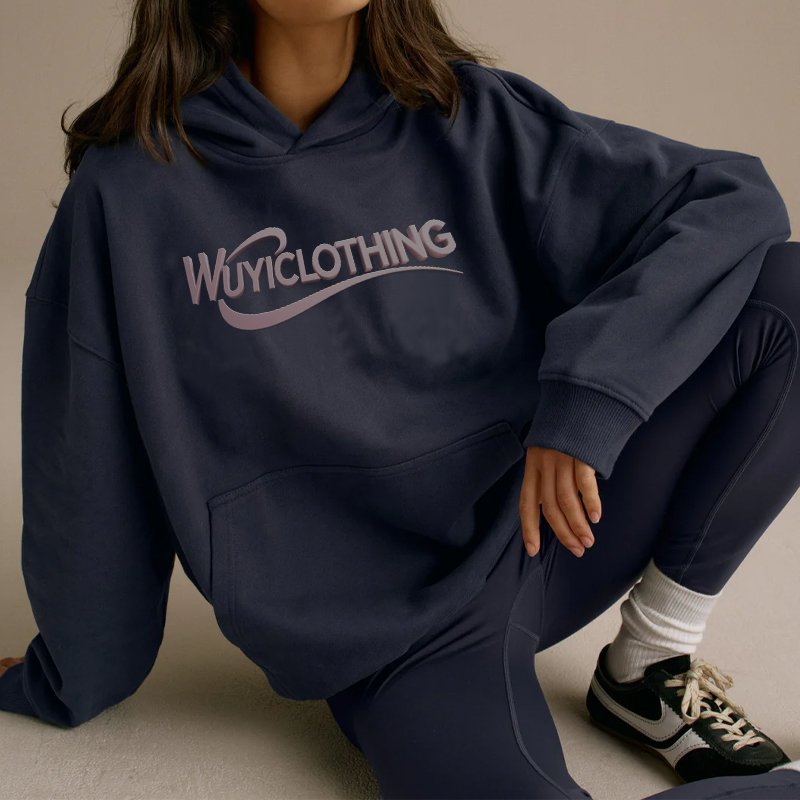
A flexible armor against uncertain times.
In the late autumn of 2023, a report from a consulting firm showed that global sales of “comfort wear” had increased by more than 40% in the past three years, with hoodies accounting for the largest share. Behind these figures lies a subtle reflection of the zeitgeist: as the certainties of the external world dissolve like sandcastles in the tide, people are beginning to seek a soft, constant anchor point within themselves. The hoodie, a functional garment born in the 1930s from the hands of New York icehouse workers, has unexpectedly become the unspoken uniform of this generation’s spirit after nearly a century of evolution.
Firstly, it provides a tangible sense of “envelopment.” Overly air-conditioned offices, sudden downpours during commutes, the unexpected silences during video conferences—life is full of subtle chills and uncertainties. A fleece-lined hoodie, slightly oversized, can create a double buffer zone, both physical and psychological. Designer Yohji Yamamoto once said, “Clothing is an extension of the body, and also the border of the soul.” The hoodie’s hood design is particularly meaningful. Putting it on slightly narrows one’s field of vision, briefly filtering out the chaotic information of the outside world, instantly creating a private space, a kind of “cocoon.” This is not escapism, but a necessary “mental disconnection,” a way to claim a moment of sovereignty for oneself in a noisy world.
More profoundly, the popularity of the hoodie reflects a gentle rebellion against the “over-performance” of daily life. Modern people are like actors in an endless play; social media demands that we be polished, the workplace expects us to be professional, and social occasions dictate our appropriate role-playing. The hoodie, with its inherent “unfinished” and “ambiguous” nature, loosens these constraints. It doesn’t deliberately display class, blurs the boundaries between formal and casual, and, with an almost “passive” stance, dissolves society’s endless “gaze” and “judgment” of the individual. Wearing a hoodie is like saying: at this moment, I refuse to accept any role assignments; I exist only as “myself.”
A secret code of identity that transcends generations and cultures.
Interestingly, the “ambiguity” of the hoodie hasn’t led to a loss of identity; instead, it has fostered a rich and infinitely expandable symbolic space, becoming a unique canvas for different groups to express their identities. It’s a mobile blank billboard, carrying ever-changing subcultural signals.
On the streets, an oversized hoodie paired with cargo pants and a skateboard is a continuation of the rebellious attitude of hip-hop culture; limited edition hoodies printed with independent band names or abstract patterns are secret badges for artistic youth to identify each other; a plain, basic hoodie might be considered an aesthetic of minimalist living by a programmer, or a battle garment for a scholar buried in their studies. From university libraries to Silicon Valley garages, from rock music festivals to contemporary art museums, the hoodie, with its astonishing inclusivity, traverses vastly different scenes and communities. It’s like a blank sheet of paper, onto which individual tastes, affiliations, and even rebelliousness can be splashed.
This cross-generational appeal makes it a rare garment that connects different generations. A fifty-year-old father might not understand the philosophy behind his son’s ripped jeans, but he might resonate with the old university hoodie in his wardrobe—it witnessed his youth, and now, in a similar form, it envelops the completely different yet equally restless dreams of the next generation. The fibers of the hoodie are woven with the warmth and stories of different eras; it creates a kind of wonderful continuity amidst differences, a generational dialogue based on the simple needs of “comfort and self-expression.”
Anchoring the Self in Flux: The Modern Paradox of the Hoodie
However, the “comfort” and “individuality” that hoodies represent also face the risk of alienation in the torrent of contemporary consumerism. When every niche symbol is quickly co-opted, printed on hoodies, and becomes a fleeting trend on the assembly line of fast fashion brands; when the slogan of “being yourself” is cleverly crafted by marketing into a new consumer directive, urging people to “express their individuality” by buying specific styles of hoodies, have we fallen into a new, more subtle trap of conformity?
This constitutes a typical paradox of modern life: we yearn to break free from the symbolic constraints of material objects (social roles) through material objects (hoodies), but may consequently become dependent on another language of material objects. The real challenge lies in whether we can clearly realize that the “sense of freedom” brought by hoodies is essentially a limited, contextual freedom. It is a tool, not an end; a raft to cross the river, not the other shore itself.
Therefore, the ultimate revelation of the hoodie may be this: it teaches us how to reserve a spiritual “empty room” for ourselves in a constantly changing world, in a minimalist and understated way. The key to that room lies not in the hoodie’s brand or style, but in whether our hearts truly find that moment of relaxation and tranquility when we wear it. When we learn to skillfully slip on this soft “modern morning robe” in the gaps between the many roles we must play, what we are defending is perhaps the most luxurious and essential thing in contemporary life—that small yet firm point of origin where we can always retreat to and reaffirm our self-existence amidst boundless wandering.
In this sense, every hoodie chosen with genuine intention is a movable sanctuary that a modern soul builds for itself. It is lightweight, yet can withstand the wind and cold; it is ordinary, yet sufficient to declare something extraordinary. When we pull up the hood, isolating a space of silence for ourselves, we successfully become an island in this overly noisy world—warm, self-sufficient, and connected to the vast ocean of humanity.
Explore More Articles from WUYI Apparel
Want to learn more about styling essentials hoodies or other apparel tips? Check out some of our other helpful articles:
- Material & Performance: The Building Blocks of a Great Hoodie
- Why Is the Boxy Crop Cut So Popular in 2026?
- How Does a Cropped Hoodie Affect Body Proportions?
- What Are the Functional Features of the 2026 “Recovery-Ready” Cut Hoodie?
- How to Style the 2026 “Work Layer” Cut Hoodie with a Blazer?
For more tips and tricks on fashion and lifestyle, don’t forget to visit our Blog Section.
Head over to our Shop Page to browse our full collection and pick your favorite essentials hoodie today!